
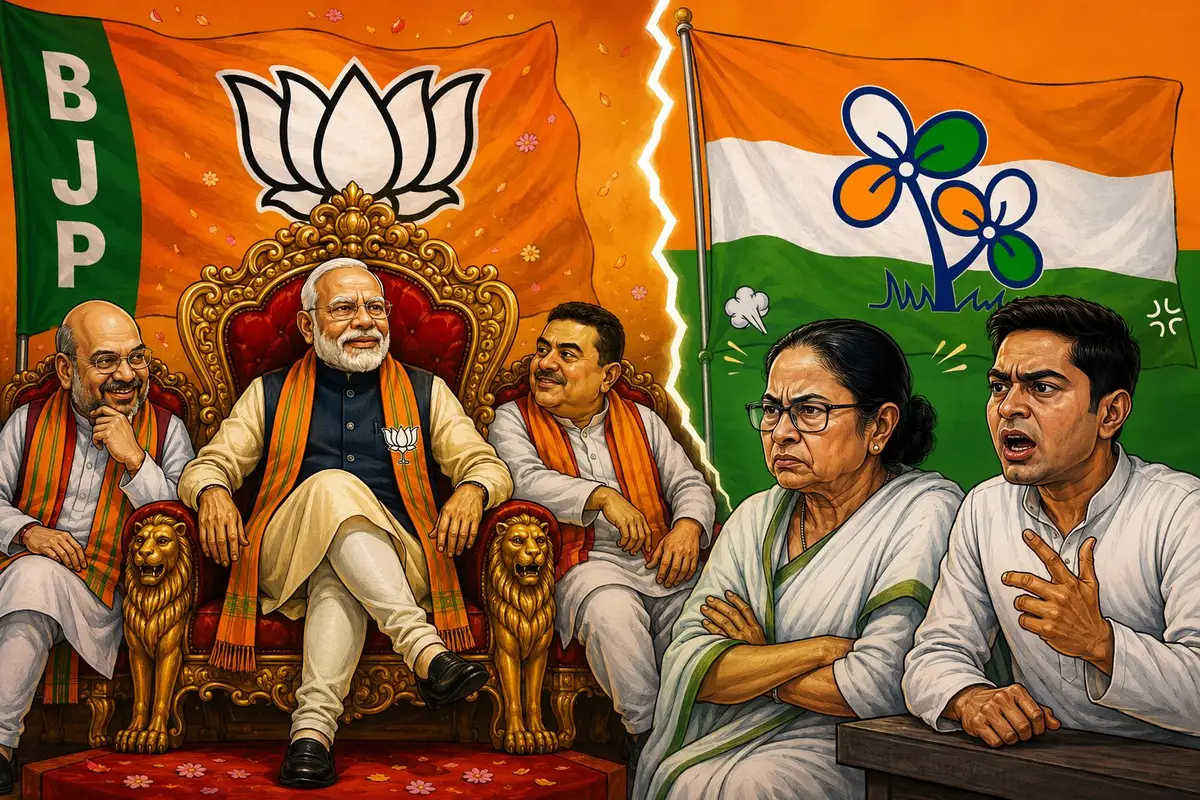
Image Credits: AI Generated
Buoyed by faith in Modi Ji’s promise of “Achhe Din,” the people of Bengal delivered a sweeping mandate to the Bharatiya Janata Party (BJP), bringing a tumultuous end to the All India Trinamool Congress’s (TMC) 15-year hold on power.
Bengal Election 2026: The Saffron Dawn
The 2026 West Bengal Assembly marked a dramatic turning point, with the Bharatiya Janata Party (BJP) securing a landslide victory over the existing All India Trinamool Congress (TMC), ending over a decade of the former CM Mamata Banerjee’s rule. On the day of the vote counting, early trends showed the BJP leading in over 90 seats, surging to a final tally of around 207-208 seats out of 293, while the TMC subsided to 79-80 seats. This outcome showed that it was the last straw for the Bengal people, disappointed by the 15-year rule of the TMC, who now people rooted and seemed to have trust in the promises made by the BJP, stating পাল্টানো দরকার, চাই বিজেপি সরকার meaning, “Change is only possible; if BJP comes to power this time”.
High-stakes contests underscored the shift. In Bhawanipore, Chief Minister Mamata Banerjee faced a neck-and-neck battle against BJP's Suvendu Adhikari, with the margin fluctuating around 2,000 votes—symbolising TMC's vulnerability. BJP's vote share hit 29.2 million, outpacing TMC's 26 million by over 3 million, particularly in areas with historical TMC strongholds.
Despite the TMC’s confidence under Mamata Banerjee—who predicted winning more than 200 seats—the BJP appealed to voters for trust and support, pledging change and development and promising accountability: if they failed to deliver, voters should replace them in five years.
Post-Election Stand-off in Bengal: Mamata Banerjee’s Defiance and the Governor’s Move
On May 5, 2026, Mamata Banerjee—flanked by Abhishek Banerjee and senior Trinamool Congress (TMC) leaders—held a press conference denying electoral defeat and alleging a Bharatiya Janata Party (BJP) conspiracy behind the party’s reversal. She declared she would neither resign nor relent, and that she intended to seek relief from the Supreme Court.
Despite her statement, her term as chief minister concluded on May 6, 2026, upon the completion of the constitutional tenure and the change in legislative arithmetic. In the immediate aftermath, the Governor announced that West Bengal would be placed under President’s Rule until a new government could be formed and sworn in.
Political Implications
The TMC’s stance frames the outcome as tainted, setting the stage for a legal and political showdown.
The BJP, for its part, presents the development as a mandate for change and a test of institutional protocols.
The Governor’s intervention signals a stopgap to ensure continuity of administration while the constitutional process for government formation proceeds.
What Comes Next
Court proceedings, if initiated, will clarify the scope of alleged irregularities and the immediate remedies available.
The Governor may invite the party or alliance claiming a majority to form the government once the numbers are verified.
Administrative continuity under President’s Rule will persist until an incoming cabinet is sworn in.
A contested verdict has moved from the podium to the courtroom and the Raj Bhavan, with West Bengal in a holding pattern until the formation of a new ministry or a judicial directive reshapes the post-poll landscape.
Voter Roll Controversies
The election faced criticism over the Election Commission's Special Intensive Revision (SIR) of voter lists, which flagged or removed nearly 12% of the electorate—over 9 million names, disproportionately affecting Muslims, migrants, and poor voters in BJP-leaning areas. Critics argued that deletions exceeded victory margins in several constituencies, raising disenfranchisement concerns.
Around 2 million voters were ultimately struck off rolls, with millions more in appeals. BJP dismissed these as routine clean-ups, while opponents like Al Jazeera highlighted them as evidence of electoral erosion. Despite probes, the process proceeded, enabling the BJP's sweep.
TMC's 2026 Bengal downfall: 15 years of scams, appeasement, and strong-arm tactics finally met their match in voters who said, "Cut money ends here."
Multiple interconnected factors fuelled the downfall of TMC in the West Bengal State Assembly Election 2026.
Anti-Incumbency and Corruption Scandals: Deep-rooted anti-incumbency after 15 years in power eroded TMC's base. Voters punished the party over high-profile scams like teacher recruitment, ration distribution, municipal hiring irregularities, coal smuggling, and cattle smuggling, leading to arrests of ministers and legislators. Large cash recoveries during raids amplified perceptions of systemic graft, overshadowing welfare schemes like Lakshmi Bhandar.
Polarisation and Appeasement Allegations: TMC's perceived minority appeasement, especially among Muslims (27% of the electorate), alienated Hindu voters. BJP capitalised on polarisation in the Matua (refugee community) and tribal areas, consolidating non-Muslim votes. Statements like Mamata Banerjee's "cow that gives milk" remark fuelled narratives of imbalance.
Voter List Revisions (SIR Impact): The Election Commission's Special Intensive Revision (SIR) removed over 9-12 million names, hitting TMC-leaning demographics like Muslims and migrants hardest. This disrupted grassroots networks, with critics claiming it swung close contests.
Rural Distress and Job Issues: Unemployment, farm price slumps, and MNREGA irregularities (including "cut money") sparked rural anger. Migration for work persisted despite welfare, as local jobs lagged; the BJP countered with promises like enhanced central schemes.
Women's Safety and RG Kar Fallout: The RG Kar hospital rape-murder incident lingered, denting TMC's women-centric image despite schemes like Kanyashree. Safety concerns amplified anti-incumbency among female voters.
Organisational Weaknesses: TMC lacked BJP/CPM-like cadre discipline, relying on local strongmen who retreated amid transfers of loyal officers. Post-poll internal revolts emerged, with leaders like Manoj Tiwary blaming top brass for ticket neglect and blocked projects.
BJP's Aggressive Campaign: BJP's micro-management, central forces, and welfare alternatives (e.g., Annapurna Bhandar) chipped away at TMC strongholds. Tighter oversight curbed TMC's alleged booth-level muscle.
Immediate Aftermath: Violence Erupts
Post-results celebrations quickly turned violent, crippling parts of West Bengal. TMC offices in districts like Baruipur, Asansol, and Jamuria were vandalised, with banners torn and structures torched. By May 6, four deaths were reported: two BJP workers and two TMC members, amid clashes in Kolkata and beyond.
TMC accused BJP of orchestrating attacks, while BJP countered that they were internal TMC feuds, denying involvement. Mamata Banerjee repeated threats amid the chaos, as Suvendu Adhikari called for calm. Police deployments and Election Commission directives aimed to curb unrest, but tensions persisted.
The most shocking incident occurred on the night of May 6, when Chandranath Rath, the personal assistant to Suvendu Adhikari, was shot dead at point-blank range in Madhyamgram. This assassination has ignited a firestorm of accusations. The BJP alleges that "TMC miscreants" are retaliating out of desperation, while the TMC has called for a court-monitored CBI probe, suggesting the violence is being engineered to justify a "clampdown" on their workers.
State police have reported two deaths and over 430 arrests since the results were announced. The tension in districts like North 24 Parganas, Birbhum, and Barrackpore remains high, with central forces being asked to stay back well beyond the election cycle to maintain a tenuous peace.
The Current Scenario: A State in Transition
As of May 8, 2026, West Bengal is in a state of constitutional flux. Governor R. N. Ravi has officially dissolved the 17th Legislative Assembly, paving the way for the first-ever BJP government in the state.
The BJP legislature party met to formally elect the next Chief Minister. While Union Home Minister Amit Shah has arrived in Kolkata as the central observer. Having defeated Mamata Banerjee twice in two consecutive elections, Suvendu Adhikari has been formally chosen by the Bharatiya Janata Party (BJP) as the new CM to lead West Bengal after Mamata Banerjee’s tenure ended.
In a move designed to mirror the historic shifts of 1977 and 2011, the BJP has announced that the swearing-in ceremony will take place on Saturday, May 9, 2026, at the iconic Brigade Parade Ground. This choice of venue is a deliberate show of strength, signalling that the "fortress of the Left and the TMC" has been fully breached.
Final Thoughts
With a new chief minister on the horizon, West Bengal looks ahead with guarded optimism, hopeful that the BJP will translate its commitments into tangible results and restore public confidence.